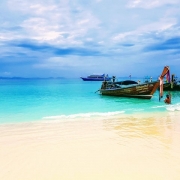
From the earliest days of the expansion of merchant sea captains from India sailing favorable winds, at the end of the Monsoon, down the eastern coastlines of the subcontinent, then across the azure Andaman Sea, Phuket has been placed firmly on the Map.
Adventurers indeed came also from the large island of Ceylon (Sri Lanka), adjacent to the Indian mainland. They ventured out towards the Straits of Malacca, and the mystical Spice Islands. On the trade route, Phuket has been a crossroads of lucrative trades, religions, and myriad business opportunities for over two thousand years. First, the spread of Hinduism, then the evolving influence of Buddhism, which still holds sway today in the kingdom, to the coming of the more modern faiths, helped make the beautiful, international tropical destination of Phuket a draw for the people towards paradise.
The early traders and merchants that established the commerce networks from Arabi & East Africa, to China & beyond, named the island, Jung Ceylon, or New Ceylon. Jung Ceylon is, coincidently, the name of the largest shopping center in Patong Beach, the tourist mecca of Phuket. When the island became a part of the emerging Kingdom of Thailand in the 1700s, the name was changed to what we know today: Phuket.
The attraction in the old days focused on tin mining and the subsequent precious stone industry, where rubies, emeralds, and sapphires were plentiful and very profitable, as a residual reward from the tin mining operations. But the fishing industry has also always flourished with Phuket having direct access to the open ocean.
After the last of three wars against Burma in the late 18th century, including a period where the Burmese actually siezed the island of Phuket and its rich resources, the Thai Kingdom placed the amazing island firmly as a Province of Thailand. Now those massive tin mines have since been reclaimed, with the earthen destruction smoothed over and beautified by public parks, recreation areas, top-rated golf courses, historical museums, resorts, even a British International school, as well as, personal residences.
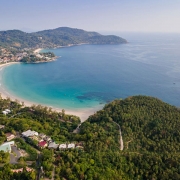
Kata Beach, placed on the south west side of the island, never did see much activity. Just a quiet fishing village for centuries, keeping its charm and semi-seclusion, by being tucked away in a perfect crescent bay adjacent the much larger and bustling Karon Beach, and also Patong Beach. Still today, holiday makers and digital nomads looking for the slower paced, simple, country life come to Kata Beach for the solitude and its natural, peaceful beauty.
Kata remained a typical, small coastal fishing village through both the 19th and 20th centuries, until the dawn of international tourism caused the eager development of Patong, Karen, Surin, and Bang Tao beaches, which eventually spilled over to Kata, with her effervescent charm, and luckily of a more sustained degree of development. Lovely Kata, with her gentle waves, and spectacular views.
Nestled in the tree covered, south corner of the bay, on a jutland point, the second project in the Horizon portfolio has some fantastic potential. Previously operated as Villa Elisabeth and reclaimed by the landowner, whom Horizons negotiates contract, the 15 existing units and villas are in need of serious renovation, but the endeavor to build an additional 10 ocean view units above the restaurant increases the value and opportunity magnificently. The Kata Beach Point project will certainly be a shining, precious jewel in the Horizons crown.
The fisherman still go out every morning, after all the centuries that have passed along that wonderful spot along the rich, blue Andaman Sea, bringing in the fresh catch of the day, for that perfect, romantic dining experience right there on the beach…